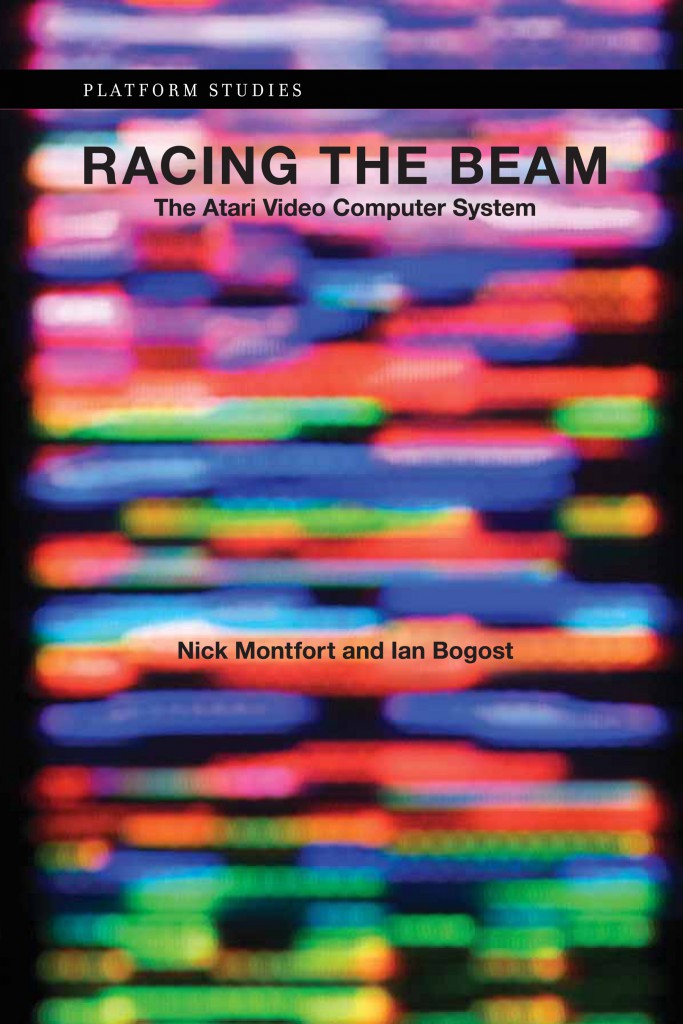
An accessible book about the Atari VCS as a platform. Co-authored with Nick Montfort.
Racing the Beam is a study of the most important early videogame console, the Atari Video Computer System (also known as the Atari VCS or the Atari 2600). Through its main example, the book provides unique insight into the role of underlying hardware and software systems in new media.
The Atari Video Computer System dominated the home videogame market so completely that "Atari" became the generic term for a videogame console. The Atari VCS was affordable and offered the flexibility of changeable cartridges. Nearly a thousand of these were created, the most significant of which established new techniques, mechanics, and even entire genres. This book offers a detailed and accessible study of this influential videogame console from both computational and cultural perspectives.
Studies of digital media have rarely investigated platforms--the systems underlying computing. This book (the first in a series of Platform Studies, also series edited by Bogost and Montfort) does so, developing a critical approach that examines the relationship between platforms and creative expression. The book covers the ancestry of the VCS (including Pong and the Atari Home Pong systems), the hardware design of the machine and its implications for creativity, and discusses many influential VCS games (Combat, Adventure, Pitfall, Pac-Man, and others). It is illustrated throught, and written to appeal to technically inclined general readers as well academics studying all sorts of creative work in digital media.
In the book, we describe the technical constraints and affordances of the system and track developments in programming, gameplay, interface, and aesthetics. Adventure, for example, was the first game to represent a virtual space larger than the screen by allowing the player to walk off one side into another space; and Star Wars: The Empire Strikes Back was an early instance of interaction between media properties and video games.
The Atari VCS -- often considered merely a retro fetish object -- is an essential part of the history of video games.
- Series Foreword
- Acknowledgements
- Timeline
- Stella
- Combat
- Adventure
- Pac-Man
- Yars' Revenge
- Pitfall!
- Star Wars: The Empire Strikes Back
- After the Crash
- Afterword on Platform Studies
- Notes
- Bibliography
- Index
- Slate.com review, by Michael Agger
- Atari 2600 made history - without memory, Toronto Star review by Darren Zenko
- Interview in the Boston Globe, by Geoff Edgers
- Crispy Gamer review, by Troy Goodfellow
- Nerve.com review, by Joe Kieser
- Racing the Beam: How Atari 2600’s Crazy Hardware Changed Game Design, Wired News review by Chris Kohler
- Retrothing review, by James Grahame
- Interview with Henry Jenkins, Part 1, Part 2
- Author Q&A at Powells.com
- Ian Bogost on the MIT Press podcast
- Review at Resurrected Entertainment, by Michael Gale
- Review in Digital Culture and Education, by Thomas Apperly
- Review by Ryan McIntyre, Managing Director of Foundry Group
- Review at YYZTech
- Review by Kim Pallister
- Racing the Beam: uma história das Materialidades do videogame Atari [PDF], review in Logos by Letícia Perani (in Portuguese)
- Review in CHOICE Magazine for academic libraries, August 2009 (46:11), "Highly recommended"
- Review in Leonardo, by Robert Jackson (September 2009)
- Review by Andrew Freck
- Review at Preserving Games
In Video Computer System, we develop the original approach of platform studies by drawing on textual studies, computer programming and engineering, and computer game studies. We consider the VCS console with its Stella chipset, along with cartridges and controllers, as evidence of human work, decisions, and processes. Our approach traces this material history while exploring the formal workings of the VCS and its early games, revealing the technological and cultural contexts in which the system and its games were developed. This study of the VCS is technically informed, explaining the operation and implications of the MOS Technologies 6507, the Television Interface Adapter, and cartridge ROM.
To encourage more studies that investigate the relationships between the hardware and software design of computing systems and the creative works produced on those systems, we have established the Platform Studies book series at the MIT Press. Authors interested in writing a book in the series should consult the series website or contact me directly.
Against Aca-Fandom
Weird Media and Tiny Ontology
Moos and Merch
Website Updates
Cow Clicker
Comments
Keith418 on Against Aca-Fandom
Ian Bogost on Against Aca-Fandom
Kristina Busse on Against Aca-Fandom
david Kociemba on Against Aca-Fandom
The Metaphysics Videogame
Cascading Failure
Top Ten Reasons I Returned My Kindle
Carrying On Over Carry-Ons
The Geek's Chihuahua
Reading Online Sucks
Chumby and the Rhetoric of Openness
A Professor's Impressions of Facebook
My Appearance on The Colbert Report
Bloomsday on Twitter